In the summer of 2025, I managed to secure a software developer internship at an automotive company. I could recall how ecstatic I was to explore and deepen my interest in the field. As part of the internship requirements, all the interns had to participate in a hackathon where we would develop and pitch ideas to improve the company’s business processes.
I was assigned with three other interns under a mentor Kris (not his real name), a senior software engineer at the company. Later that afternoon, he arranged to meet us in office. We gathered in a glass-walled conference room where we were comfortably seated on sofas, all starry-eyed and eager to contribute our ideas.
“Okay, the company wants us to think of something that could help the Power Tools department.” Kris said.
power tools are things like hand drills, grinders, etc
“How about something that could help with market analysis?” I replied.
“Yes, we could build a chatbot that allows analysts to easily visualise and understand market trends,” one of the other interns said.
“We could feed sales data into a Large Language Model,” another intern followed.
Soon, we were deep into technical jargons and exchanging ideas.
“Ok guys, guys… if we want to win this hackathon. Forget the boilerplate.” Kris said, with a blank code editor window on his right.
“Have you tried AI coding tools like Claude Code, Cursor or Copilot? We don’t need to code anymore. All we need are a few simple prompts.” He continued.
“But shouldn’t we first agree on the tools and frameworks we are going to use? And decide on our roles and responsibilities?” we questioned.
Kris waved a hand, dismissing the concern as if we were asking about the weather. “Use whatever you like. It doesn’t matter.”
“I could craft the user interface first before we meet tomorrow,” I offered.
“And I could perhaps research into chatbot projects using Python?” the other intern suggested.
python: the programming language, not the snake 😶
“Sure, sounds great… see you tomorrow!” Kris said.
The next day, we were sitting together around a table in the event room with our identical company-issued ThinkPads. The white, fluorescent lights hummed with a headache-inducing frequency.
“Here’s the user interface I did last night,” I said, turning my laptop around to show Kris the work I had completed.
“We’ve also discussed the architectural diagram with cloud integration earlier,” the other interns added on.
“Guys… hold on! I’ve already finished the whole thing,” Kris interrupted our discussion.
Both in disbelief and confusion, we stood up and gathered behind his laptop. Kris turned back to his screen and started typing.
“What power tool has the best sales.” We waited excitedly every second that seemed like forever. Nearly a minute after, the screen showed an error occurred while trying to process the message.
“Hold on guys! Let me be more exact with my question…” Kris reasoned. “Show me the top five power tools with the highest sales revenue.”
Another minute passed, the chatbot replied with lengthy, unformatted text that was barely readable.
“With this, we are so going to win!” Kris chuckled.
We stared at each other, puzzled and doubtful. Admittedly, I was slightly irritated that this was not discussed together at all. The sleek user interface I had meticulously designed and worked overtime for was in vain…
“I need all your help to focus on debugging this,” Kris instructed. “Refer to this documentation to get started.”
From this point, it was the greatest struggle I had ever faced. I wanted to help but I didn’t know how to.
“Hey Kris, we are encountering this error setting up the chatbot to run locally. Could you help us to troubleshoot this?” I asked, on behalf of the other interns.
“Hold on… let me fix this first,” Kris turned back to his laptop screen and began to type.
“Fix this formatting bug in the chatbot replies,”
“Watch this,” he said.
We watched his screen in a sort of hypnotic trance. Block after block of code materialized, perfectly indented and hauntingly confident. But Kris didn’t read the code at all. He was simply scrolling through, nodding and approving every code change that AI suggested.
To no surprise, the AI’s confidence proved to be a lie. And the solution? “Prompt again until it works,” Kris persisted. But with each new prompt K threw in, the AI spat out more unexplainable bugs. Instead of solving the problem, it got worse—and this was just one of many bugs we had encountered.
So, after hours fighting the machine, we barely made any progress. The application didn’t just fail – it disintegrated. We hit a dead-end.
“Guys. I have a headache,” Kris finally said, his eyes bleary and resigned. “I’m leaving now. I trust you guys can handle the remaining bugs and the presentation slides?”
“Okay…” we replied and nodded hesitantly. That moment, the air in the room felt heavy with the realization that he was handing us a black box. He was leaving us with ten thousand lines of ‘logic’ that none of us—not even the man who developed it— actually understood.
As we sat there in the silence of the after-hours office, the true cost of AI over-reliance became clear. In those final hours, we got the chatbot to run and scripted a sequence of premeditated prompts that would not trigger the chatbot from crashing. It was a bare skeleton, hollow at its core. Held together by hope, it proved functionally stable enough to scrape through a three-minute pitch.
My hackathon experience was a catalyst for a deeper realization: AI hasn’t just reshaped our individual workflows; it has fundamentally altered how we collaborate and work as a team. While modern AI tools have granted us a seductive sense of speed, it simultaneously introduced a layer of profound misunderstanding and miscommunication.
In the software industry, we are beginning to call this phenomenon “vibe coding”. Popularized by AI pioneer Andrej Karpathy, the term describes a shift where developers use natural language to prompt AI to generate computer code. But as I learned, when we start “vibing” with a machine, we often stop communicating with each other.
More than just a shortcut, being reliant on AI also encourages teams to work in silos. We feel that our queries could easily and supposedly be answered by a Large Language Model (LLM), like ChatGPT, Claude or Gemini. Psychologically, humans gravitate towards the path of least resistance. It’s far easier to reach out to your favourite LLM than having to trouble your colleague for help and go through the “messiness” of a human conversation.
Ironically, this is where Conway’s law bites back, particularly in vibe coding. The law states that an organization’s design systems would mirror its own communication structure. In our case, since our communication had atomized into private, one-on-one sessions with our respective AI tools, the software followed this structure too.
Akin to building a house without a proper blueprint, a lack of communication resulted in a disorganised system with integration issues from isolated work. Because we weren’t talking, our code wasn’t talking. Without proper planning and a shared understanding, our chatbot ended up like a house of cards, ready to fall the moment there’s a slightest bug.
While it feels like we could get our work done faster initially, vibe coding, especially without guardrails or understanding, could in fact slow down development as the application grows. Even with faster output, vibe coding can generate convoluted code and security vulnerabilities. This quickly results in “AI slop” which in fact creates more work for others to interpret, correct or even redo the whole product.
As an application becomes more complex, AI tools like LLMs would also lose their effectiveness because of their limited context window i.e. how much the LLM can remember at any one time. When the whole system becomes a big black box, developers struggle to understand, making it harder to debug, maintain or develop the software application.
Beyond the software industry, more of us are increasingly using some form of AI tool in our daily lives and increasingly becoming susceptible to automation bias. The psychological tendency to favour suggestions from an automated system, even when they contradict our own judgement. Somehow, we treat these generated answers with an unearned reverence. It doesn’t help that the media often over-glorifies AI as a digital oracle, but the reality is far from this…
Under the hood, AI is merely a statistical engine that lacks human intuition; it calculates probabilities and builds responses to the user’s input based on the trillions of data points it was fed. It does not “understand” the problem; it simply predicts the most likely solution.
 machine “learning”
Using LLMs does not mean we should blindly agree and stop applying critical thinking skills to evaluate their output. To enable these AI tools to cooperate and augment its functionality, having the expert oversight to prompt correctly and monitor its output is necessary to bridge the gap between statistical probability and functional reality.
AI Hype
Much of the AI revolution or drama today is led by a notable group of tech companies and billionaires with distinct philosophies, but with the vague common goal of achieving Artificial General Intelligence (AGI) - AI that matches or exceeds human cognitive abilities, like those in sci-fi movies…
These companies have employed fear-mongering tactics, claiming the existential threats of AGI and how AGI is right around the corner. Following suit, the corporate world is persuaded to panic buy into their products and services to avoid losing out. This turned out to be an effective marketing strategy driven by profit and ideology rather than scientific evidence.
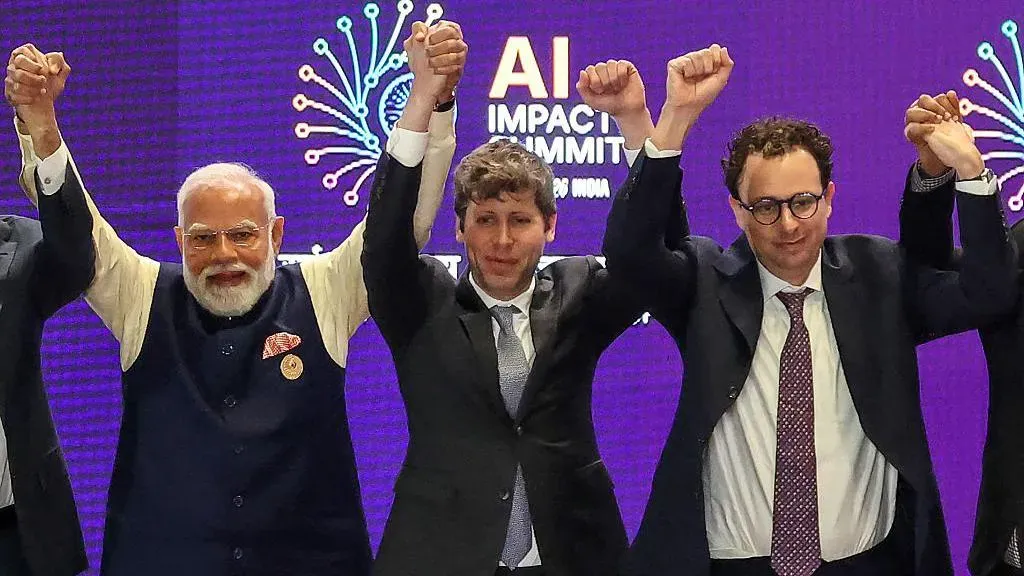 From friends to foes: OpenAI’s CEO Sam Altman and Anthropic’s CEO Dario Amodei refuse to hold hands at India AI Impact Summit 2026
Meanwhile, tech giants continue to clash in courtrooms and debate at global summits, as they rival for more power and money in the AI industry. While this has tarnished the industry’s reputation that originated as a non-profit mission, the increased commercialisation of AI and continuation of the AGI arms race would attract and sustain investments. Investors continue to bet money on big tech firms that they can deliver on their grandiose promises on AGI despite diminishing returns.
 agi’s got our back? 🌚
Source
AI Concerns
Environmental Impacts
As AI companies continue to scale their technologies with more data, compute and energy, it also comes at an environmental cost to compensate for its increasing energy demand on data centres. In attempts to reach AGI, big tech companies are drawing large amounts of electricity to train bigger model several times in order to maximise performance.
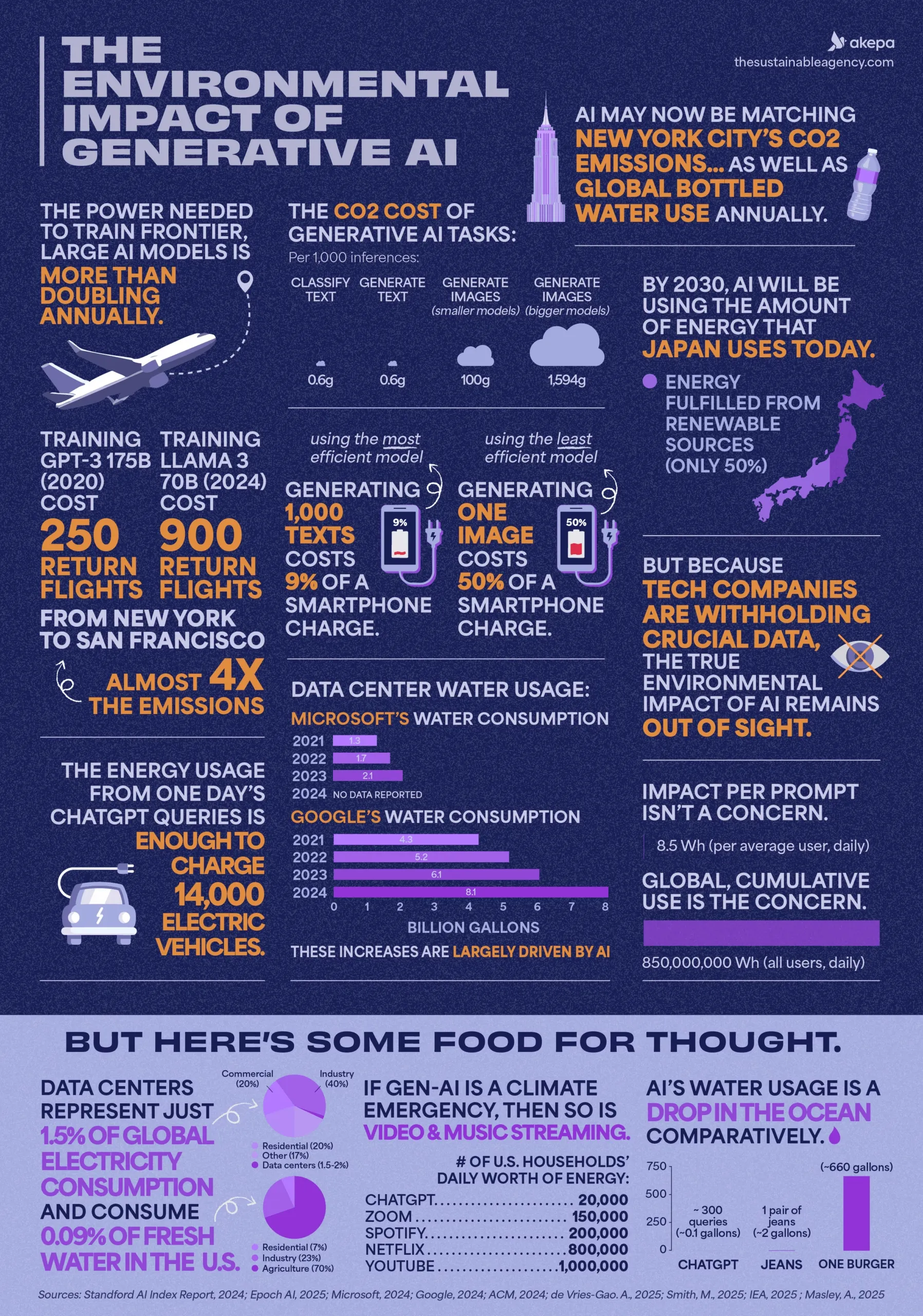
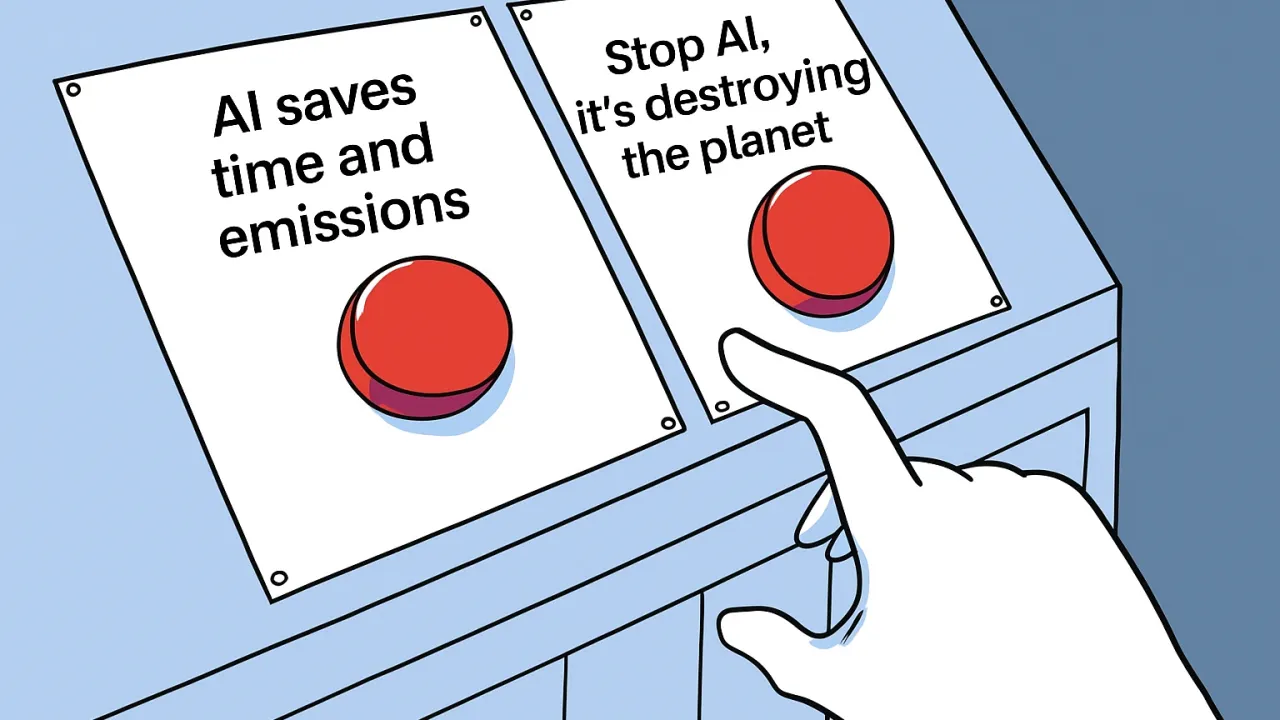
On the flip side, AI development could also lead to breakthroughs in addressing climate issues, potentially reducing greenhouse gas emissions with tools that can predict weather, improve waste management and clean up marine plastic.
Companies have also highlighted plans to make AI more efficient. Many big firms are committed to using renewable energy to power its AI operations. Data centres are also developing more efficient cooling methods, and researchers are designing more powerful chips and energy-reducing algorithms.
Reflecting on my own personal use, AI has greatly reduced my time spent crawling aimlessly through the web to find what I need, even though a single AI query uses more energy compared to a Google search. Overall, I don’t think the cost amounts to a significant value an individual should feel guilty about.
Of course, if we consider global cumulative use, this would be a different story.
The challenge then lies in balancing AI development responsibly, encouraging moderate usage across stakeholders while pushing for AI applications that brings about environmental benefits.
Ethical issues
As magical as ChatGPT first gained popularity in 2022, nearly every stage of building these large language models require vast amounts of labelled, quality data. Large AI companies typically outsource this work to subcontractors. To maximise profits, these subcontractors would hire and manage workers from less developed countries like Kenya and Venezuela, often where labour rights are not strictly enforced.

This army of underpaid gig workers include data labellers to annotate data and content moderators who are responsible for flagging inappropriate content to train the models effectively. Unfortunately, these workers are often invisible to the public as they are employed abroad.
While new laws and policies have been introduced now to hold big tech businesses and crowdsourcing companies publicly accountable for fair working conditions, ethical AI development today still remains a prevalent issue across the production chain where more progress can be made.
Mental health
A new field is also emerging, exploring the psychological impacts on its users arising from AI over-reliance. There have been recent reports where users have become obsessively attached to their chatbots, experienced delusional thinking or had their pre-existing mental health conditions worsened. This phenomenon is sometimes termed “ChatGPT-induced psychosis”, a growing public health concern stemming from prolonged AI use.
Then there are studies that show that relying on AI might make us dumber, as we “cognitive offload” our thinking and reasoning to AI, which in turn reduces our own cognitive abilities.
For both of these cases, the evidence is still not yet conclusive, and some of their claims are speculative. Scientific research into long-term human-AI interactions are still ongoing.
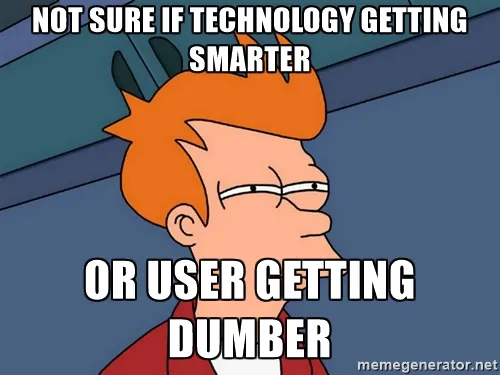
In the end, I feel it really boils down to how we use these tools to best help us. If we feed garbage in, then we will likely receive garbage out. Having the foundational skills, and the capacity to pause, think and refine our prompts before we hit enter is more important than ever.
AI Reality
The whole AI bubble is surrounded by uncertainty that is unsettling for many of us. As AI existential threats and a depressed hires rate continue to loom, fresh graduates in particular are facing an abysmal job market.
Former Google’s CEO Eric Schimdt commencement speech at the University of Arizona is a case in point. Students booed Schmidt over his AI statements, highlighting the growing anxiety and hatred over AI’s impact on jobs.
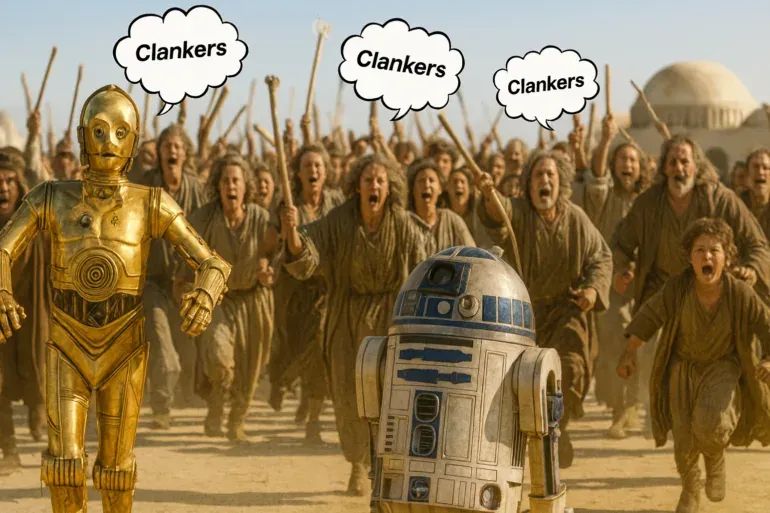 “Not the C word 😵💫” - AI
Recently back in Singapore, companies are restructuring, citing automation and AI adoption as one of the reasons to reduce headcounts. Clearly, this isn’t the first time we are hearing about this. I think we all should be prepared for the corporate reality that some jobs would disappear, some would change and new ones would appear.
This means that the nature of some of our work would no doubt be intertwined with AI tools one day. It would be futile to push back against these changes and reject AI entirely. To adapt effectively and stay relevant, we should not see AI as replacement of our own judgement. Having the knowledge to discern when AI is hallucinating and to evaluate its output can greatly value-add to our professional lives.
If we look past the whole hype and political feud, AI has valid use cases in healthcare, industrial automation and education, from medical imaging diagnostics, predictive maintenance to immediate academic feedback reports. As the technology continues to mature, we should ask ourselves: how can we continue to add the human touch in the age of AI and automation? I am certain this will matter a lot more in the foreseeable future.
I still believe we cannot let the machine do all the thinking for us, as we are the ones scaffolding the soul of our work. Prompt as much as we like, AI for sure isn’t going to resolve the political dramas, social issues and communication problems we are facing.
Closing thoughts
Months after the hackathon, I enquired with the intern who took over the development of the chatbot. He told me the entire system was completely rewritten. And it was not surprising.
In the age of AI where we are all increasingly exposed to this new wave of technology, I propose that we consider this for our own well-being:
Think more, prompt less
- Rayson (2026)
 yup pls think like this monkey…
Lastly, I swear this post is not 100% AI-generated 🤐. That would be ironic, isn’t it? HAHAH anyway, I hope I’ve provided an overview of the AI saga together with my own experience that’s peppered with my personal insights. Feel free to share some thoughts that are yours truly down below.
Further reading
- Vibe coding: programming through conversation with artificial intelligence
- Conway’s law - Wikipedia
- Assessing the Quality and Security of AI-Generated Code: A Quantitative Analysis
- AI-Generated “Workslop” Is Destroying Productivity
- AI Safety and Automation Bias | Center for Security and Emerging Technology
- 1.1: The AGI Mythology: The Argument to End All Arguments - AI Now Institute
- Why the AI industry is the real winner of the Musk-Altman trial
- The AI Scaling Wall of Diminishing Returns
- Environmental Impact of Generative AI | Stats & Facts for 2026
- AI and the Energy Issue - Ethics Unwrapped
- What’s the carbon footprint of using ChatGPT?
- The AI Revolution Comes With the Exploitation of Gig Workers - AlgorithmWatch
- Economy and Exploitation: The AI Industry’s Unjust Labor Practices – UAB Institute for Human Rights Blog
- The Exploited Labor Behind Artificial Intelligence
- Minds in Crisis: How the AI Revolution is Impacting Mental Health
- Is AI Making Our Brains Weaker?
- Technology Makes Us Dumber If We Let It | Game-Changer
- Class of 2026: A depressed hires rate is a major cause of labor market weakness for young college graduates | Economic Policy Institute
- Former Google CEO Eric Schmidt booed by graduates at mention of AI
- Singapore’s AI-job cuts debate flares over ‘lower-value human capital’ remark | South China Morning Post
Comments